

Back in January, the signals around Power Apps per app end of sale looked fairly straightforward: Microsoft had finally decided to shut the door on the old $5 per app license for new customers. Since then, however, a couple of new public clues have emerged that make the story more interesting.
The biggest change is on Microsoft’s own licensing announcement page. It now says that while the Power Apps per app SKU is no longer available for purchase by new customers in general, existing AND new CSP customers will not be impacted. They can continue to purchase, use, and renew the subscription, with Microsoft noting that the SKU should reappear on the CSP price lists in early April. The page even includes a footnote saying this CSP clarification was added on March 6, 2026.
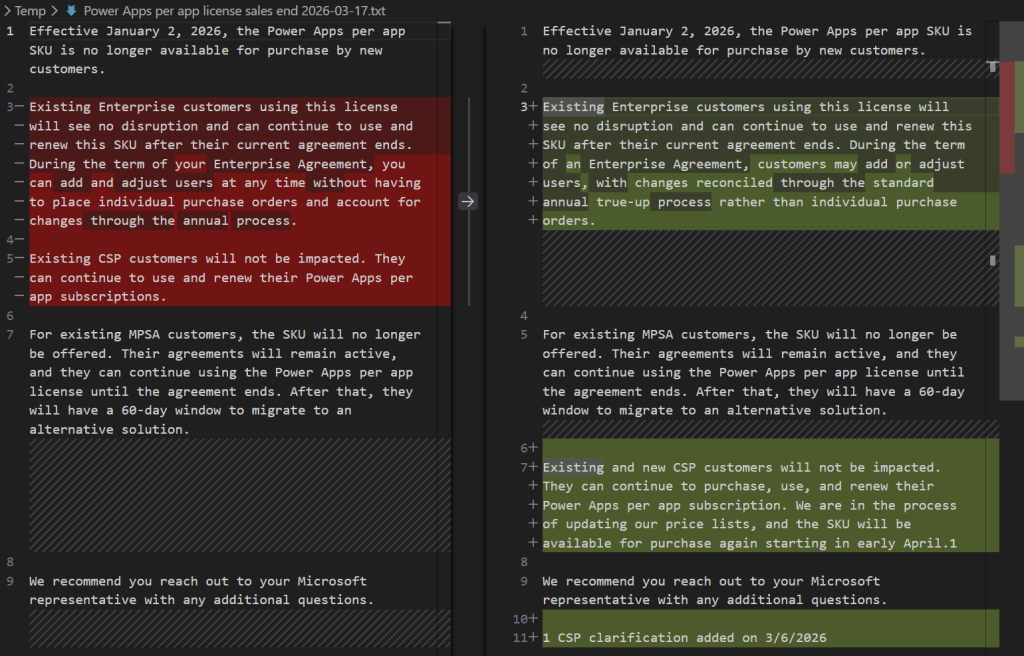
That is a notable shift from the earlier public wording. The February 14 archived version of the same post only said that existing CSP customers could continue to use and renew their subscriptions. In other words, the current message is no longer just about protecting existing customers. It explicitly opens the door for new CSP customers too, which is a new signal not shown before.
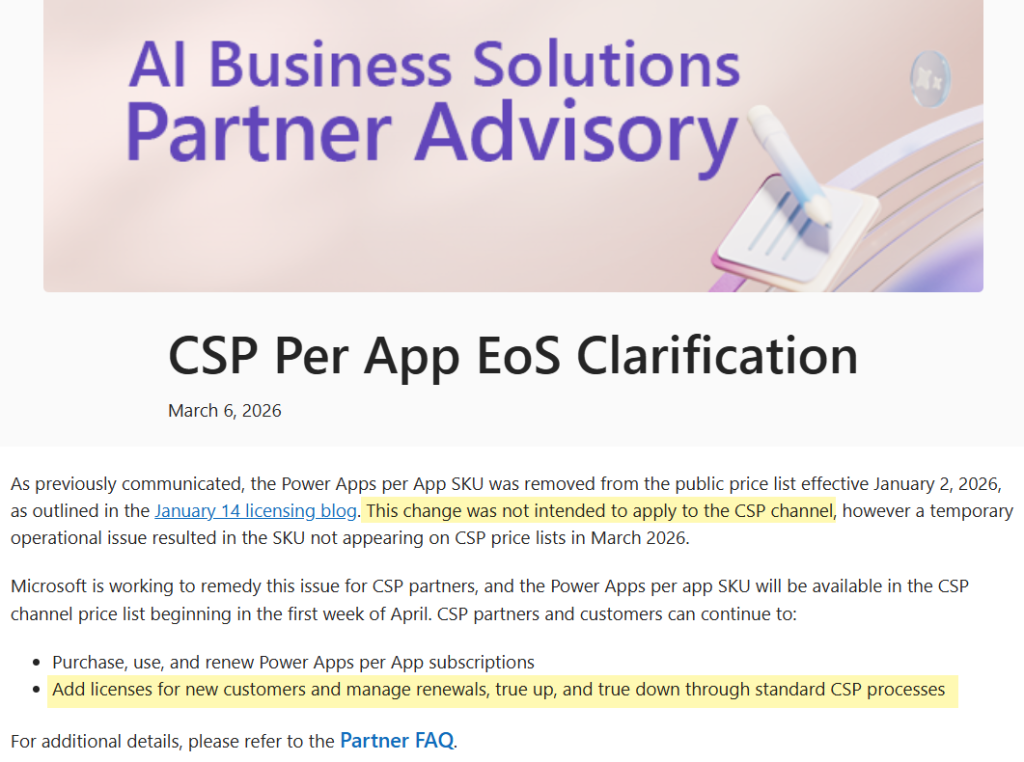
There was also a separate partner-facing (yet public) clarification posted on March 6 saying that the SKU disappearing from CSP price lists was a temporary operational issue, not the intended policy. Based on that and the edit to the original announcement, this official communication now reads less like “Microsoft brought per app back” and more like “CSP was never meant to be included in the shutdown the same way as the other channels.”
So why would CSP be treated differently from EA and MPSA?
Looking at the subscription management technicalities, there should not have been a reason for such a 180. Even after End-of-sale is announced, subscriptions can be transferred in CSP. This would not make the customers locked in with their current partner but rather provide them the path to take the Power Apps per app licenses elsewhere, regardless of the EOS state.
One theory is that this is about channel continuity. Several partners have been voicing their concerns about the elimination of the $5 entry point to Microsoft Power Platform based solutions. Especially ISVs that have built their products on top of this platform and want to offer it to customers with no prior low-code platform commitments, requiring either the $20 Power Apps Premium or the $10 pay-as-you-go Azure billing for active monthly users would have meant a higher barrier.
Perhaps the critical thing for Microsoft at this point has been to clear away the $5 license from their own public price lists. When the new customers who buy licenses directly from the Microsoft 365 Admin Center will no longer see Per App offered, the presence of this licensing option will keep diminishing. We should remember that Microsoft took away the $5 option from their Power Apps marketing pages already in 2023, causing widespread speculation about the end of Per App licenses.
Is the recent decision now “the end of End Of Sale” for Power Apps Per App? Yes and no. For other channels, EOS still stands. In CSP, EOS is not a separate abstract status that overrides commerce. Microsoft documents EOS as taking effect through the price list and Partner Center catalog. If the SKU is back on the active CSP price list and purchasable in catalog, that is the operative reality for CSP.
As a quick explainer to customers, CSP stands for Cloud Solution Provider and is essentially a Microsoft partner that resells licenses and other services. They’ll bill you for the licenses and also act as the first point of contact. Buying through Microsoft 365 admin center is Microsoft’s Web Direct motion, usually under MCA billing. That channel will no longer offer Per App licenses to new customers and you should look for a CSP in your area instead.