

In December 2025, Microsoft added a new section to the Power Platform licensing guide that signals where “agentic access to Dataverse” is headed. It’s short, but it introduces a licensing model that’s different from what most of us are used to with Power Apps, Dataverse, and Dynamics 365. This post outlines not just the update but the reasons why MCP Dataverse Server licensing is a new dimension that also non-developer audiences need to understand.
- Power Platform licensing guide update
- What are MCP servers anyway?
- When should we think about MCP licensing specifically?
- Scenario 1: Dynamics 365 Sales Enterprise users and agentic AI
- Scenario 2: Power Apps plus Copilot Studio
- Scenario 3: Dataverse and custom AI agents
- You can't assume MCP server access is always allowed
- Preparing for the Agentic Control Plane
Power Platform licensing guide update
Here’s what was added (verbatim):
The Dataverse MCP (Model Context Protocol) server provides a standardized, secure way for AI agents to access and act on enterprise data through natural language. After connecting to the Dataverse MCP Server for a specific environment, agents can use Dataverse MCP tools within the Power Platform to query, manage and interact with data.
Access requirements
Agents built outside Copilot Studio require User SLs to authenticate and access the Dataverse MCP Server and Dataverse MCP tools.
Licensing requirements
* Access to non-Dynamics 365 data is included with the Microsoft 365 Copilot User SL.
* Access to Dynamics 365 Data is included with a Dynamics 365 Premium license (Dynamics 365 Sales Premium, Finance Premium, Supply Chain Management Premium and Customer Service Premium).
* Other applicable licenses are charged per tool call.
Billing
* Dataverse MCP tools are billed at the same rate as AI tools (basic), per Copilot Credit consumption rates.
* Dataverse grounding resource calls (e.g., Search and Fetch tool calls) are billed at the same rate as tenant graph grounding, per published billing rates.
For a detailed list of Dataverse MCP tools, please see Dataverse MCP tools.
What are MCP servers anyway?
MCP (Model Context Protocol) is basically a standard way to let an AI agent call “tools” against a system: search data, fetch records, create/update things, etc. The important shift is that MCP turns Dataverse into a tool endpoint for agents — not just a database behind Dynamics 365 apps or Power Apps.
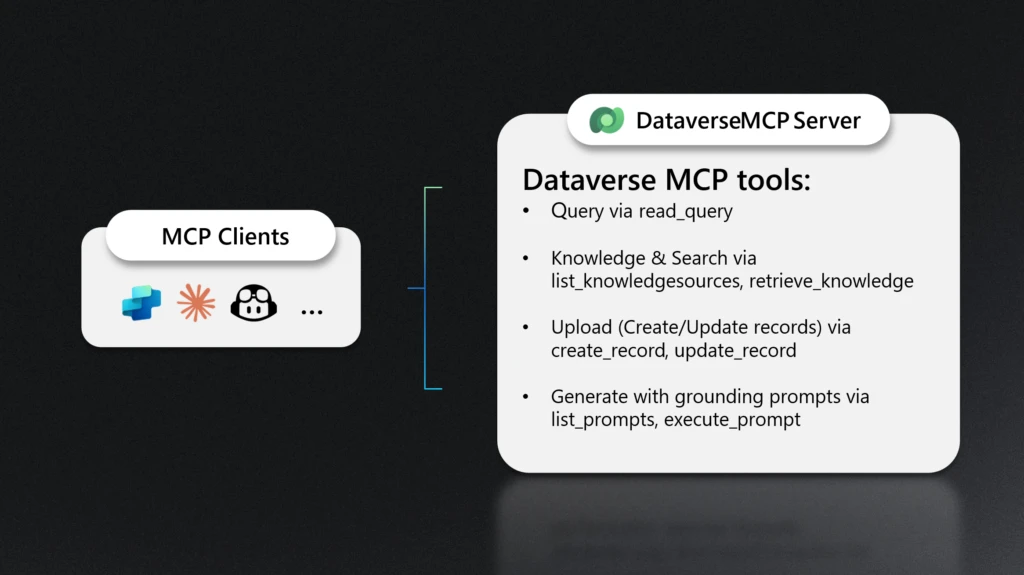
From a licensing standpoint, this matters because “an agent calling tools” doesn’t map cleanly to the traditional story of:
- “a user runs an app” (Power Apps per user/per app), or
- “a user uses Dynamics 365” (Sales/CS/Finance licensing), or
- “a flow runs in the background” (Power Automate licensing).
Microsoft’s answer seems to be: when Dataverse is accessed as an agent tool surface, it belongs in the Copilot Credits economy (tool calls + grounding calls), and it’s gated by specific User SL entitlements — depending on where the AI agent runs.
Also: yes, this is where the multiplexing topic raises its head. I’m not going deep into that here, but if you’re thinking about “one agent account serves many humans”, you should already feel the direction this is going…
When should we think about MCP licensing specifically?
With classic Microsoft business applications deployments, the licensing model had two basic directions to approach it from: is this a Dynamics 365 based solution from Microsoft, or a Power Platform based custom solution built by someone else? Sure, you would be using largely the exact same technology in the solution components, yet you had to know which licensing guide to pick first.
The arrival of agentic AI changes the licensing discussion. Not only are we now talking about the per-agent licensing model of Microsoft Agent 365. Customers are increasingly pushed towards new interaction patterns in the business processes managed on MS cloud tools. Yes, Copilot is everywhere and Microsoft really wants every user experience to start from there.
The first-party Dynamics 365 products have an ever-growing list of different agents in their list of features. Depending on the depth of functionality, even these can require purchases of Copilot credits separately from the traditional user-based licenses of Dynamics 365. Yet they represent a preconfigured agent experience for specific processes, such as Sales Qualification Agent, Sales Research Agent and Sales Close Agent in the Dynamics 365 Sales AI agents list.
Many customers will be looking for something more specific, though. They will likely not start merely from the template agents if the organization is serious about introducing AI agents as their digital workforce alongside human employees. When building custom agents with consultants specializing in AI solutions, the use of MCP servers will be assumed as a given — especially if the Microsoft bizapps stack is not that familiar to them.
Let’s look at three common scenarios and how they are impacted by these Dataverse MCP Server licensing terms.
Scenario 1: Dynamics 365 Sales Enterprise users and agentic AI
The line that jumps out from Microsoft’s new licensing documentation is this one:
- “Access to Dynamics 365 Data is included with a Dynamics 365 Premium license (…Sales Premium…)”
Notice what’s not listed: Sales Enterprise. The most common baseline Dynamics 365 CRM license out there. That doesn’t automatically mean “Sales Enterprise can’t do this”, but it does mean:
- If you plan to have agents access Dynamics 365 data via the Dataverse MCP tools, Microsoft is explicitly calling out Premium as the clean entitlement that includes that access.
- If you don’t have Premium, you should expect the licensing conversation to shift to “what other applicable licenses apply” and what gets “charged per tool call”.
In practice, this creates a new planning question for Sales customers experimenting with AI agents:
- Are we doing “Copilot-first” (where Microsoft 365 Copilot User SL might be the umbrella for lots of things)?
- Or are we doing “Dynamics-first” (where Premium SKUs become the safe harbor)?
If you’re a Sales Enterprise shop hoping to pilot agentic scenarios without changing license mix, this addition is basically a warning: check the SKU assumptions before your AI agent prototype becomes production.
Scenario 2: Power Apps plus Copilot Studio
If you stay inside Copilot Studio, you’re already living in a world where some interactions are covered by user licenses, while others consume Copilot Credits depending on what the agent does.
The addition of Dataverse MCP Server into the licensing guide changes the role of Dataverse from mere data source/target to agent tools provider:
- Dataverse MCP tools are billed like AI tools (basic) (Copilot Credits).
- Search/Fetch grounding calls are billed like tenant graph grounding (even more Copilot Credits).
The surprising part here is how Power Platform licensing is no longer the only currency to pay for access to platform functionality:
- “Access to non-Dynamics 365 data is included with the Microsoft 365 Copilot User SL.”
You may have licensed your custom low-code application users with Power Apps Premium ($20 per user) or Power Apps per app ($5 per app). While this gives you full access rights to Dataverse data in the given environment, the agent tools provided by Dataverse MCP Server are now handled differently. The $30 per user M365 Copilot license is now positioned as a way to unlock usage outside Copilot. If you stay within Copilot Studio, though, no additional user license is needed.
Scenario 3: Dataverse and custom AI agents
This is the scenario most impacted by the Dataverse MCP Server licensing rules:
- “Agents built outside Copilot Studio require User SLs to authenticate and access the Dataverse MCP Server and Dataverse MCP tools.”
So if you’re building your own agent (code-first, third-party agent shell, desktop client, your own orchestrator), and you want to use Dataverse through the official MCP interface, you need to pause for a moment and think.
- You need a licensed user identity (not a “free bot” identity).
- You should expect per-tool-call billing (Copilot Credits).
- Your “included access” depends on what data you’re touching:
- non-Dynamics data: tied to Microsoft 365 Copilot User SL
- Dynamics data: tied to Dynamics 365 Premium
- everything else: “other applicable licenses” + tool-call charging
The “developer surprise” here is that many of us have historically treated Dataverse access as “just another API surface” once the underlying Power Apps/Dynamics entitlements are in place. MCP is being positioned differently: it’s the agent tool surface, and Microsoft is clearly reserving the right to price it like one.
You can’t assume MCP server access is always allowed
Today, business users or even low-code app makers rarely deal with MCP servers. We’ve seen how Microsoft is positioning them as a key component in the business applications space. Especially in the Finance and Operations (F&O) side where the Dynamics 365 ERP MCP Server is said to offer “a shared foundation for ERP and AI”.

Pay attention to the details: Dynamics 365 ERP MCP Server is not the same as the Dataverse MCP Server. It may be obvious to the tech professionals, but as a reminder: Dynamics 365 ERP and CRM are two completely different things. The latter runs on Dataverse, the former does not (even though integrations are gradually becoming tighter).
It might seem like a non-issue to cover users with the required licensing for Dataverse MCP Server, if you just consider this a business-as-usual USL assignment. What we need to remember, though, is that these are not mainstream license types today. First of all, out of all the Microsoft 365 licensed users globally, roughly 2% have the premium Microsoft 365 Copilot license today.
As for the Dynamics 365 licenses, the pricing gap is even wider. Rather than the $30 per user cost of M365 Copilot premium, the list prices between Dynamics 365 Sales Enterprise and Sales Premium have a $45 per month difference. For ERP products like Finance, the jump to premium is $90 more. Ouch!

One might rightfully assume that customers with their CRM and ERP data inside MS cloud would naturally build on the MS agentic AI tooling anyway. But that’s not the question here: you might be building agents within Microsoft’s cloud and still face additional licensing requirements.
Professional developers and AI experts will often favor using pro-code tools for building agentic solutions. Microsoft Foundry (formerly Azure AI Foundry) is “a unified Azure platform-as-a-service offering for enterprise AI operations, model builders, and application development.” When developing custom AI agents with OpenAI SDK, for example, you’re not working within Copilot Studio. Thus, the Dataverse MCP Server licensing requirement kicks in.
Even if you would be developing a low-code solution that eventually does operate on Microsoft Copilot Studio, pay attention to the tooling your developers are leveraging. Are they using GitHub Copilot in Visual Studio Code and connecting to Dataverse MCP Server? Licensing rules apply. Creating code with non-Microsoft MCP client like Claude that talks to Dataverse MCP Server? You better have the development team licensed with M365 Copilot or D365 Premium.
Preparing for the Agentic Control Plane
“But doesn’t this MCP Server tax kill the idea of autonomous AI agents working with Dataverse?” Well, not necessarily. Remember the big Ignite 2025 announcement of Microsoft Agent 365? What did Satya Nadella say about per-agent licensing alongside the per-user model? As we wait for what the final pricing of A365 SKU is going to be, as well as what Microsoft services A365 covers, one thing we can expect to see included is the MCP Server access for managed agents.
Think about it: isn’t it quite a convenient way for Microsoft to ensure that existing third-party agents get deployed via Agent 365, to ensure not just governance and observability but also compliance with licensing terms? Exactly.
2026 is shaping up to be potentially a transformative year for Microsoft licensing models. Many of the POCs and Copilot Studio experiments can be expected to reach a stage where customers think about “okay, how do we make this production ready for the entire enterprise user base?” As more and more Microsoft AI services reach GA status and their preview stage with TBD licensing terms comes to an end, the real cost of agentic AI shall be revealed.
I, for one, can’t wait for the coming licensing announcements!🍿 Be sure to bookmark licensing.guide and check back for the latest blog posts. And if you need one-to-one guidance on any of these topics, don’t be afraid to reach out to me.


Interesting. So:
A) all digital workforce will require respective D365 licenses (the new per-user per-agent model),
B) if some users previously held limited D365 licenses (lets say, for viewing dashboards only) but now use agents, their licenses would need to be upgraded to Premium?
Definitely something orgs (particularly SMEs) will need to factor into future “agentic AI tech landscape” planning.
If they are using Dynamics 365 related AI agents built with Copilot Studio, there is no need for the Premium tier. But user identities that perform operations using Dataverse MCP Server from outside that platform will need that USL tier now, based on the licensing guide update.