

Together with the Microsoft 365 E7 announcement (see my cheeky Ea7y-E take here), Microsoft also set the General Availability date for Microsoft Agent 365: May 1, 2026. We also got the price when buying A365 outside the E7 bundle: $15 per user per month. The launch post for Agent 365 on the Microsoft security blog is here.
The immediate question for the regular readers of my blog should be “what happened to the per-agent model?” At least that was my first thought. As always, Microsoft’s announcement of GA dates isn’t equal to the full release of the licensing terms. We don’t have all the official sources yet to dive deep into this topic, but that’s what independent licensing expert blogs are for, right?
Agents working on behalf of Microsoft 365 users
Many have speculated it, and in the recent Agent 365 product team AMA session it was confirmed: the key reason for choosing this per user licensing model is budgeting predictability. Customers do not yet know how many AI agents they are actually supposed to govern, especially when the control plane for discovering that inventory is the very Agent 365 service now being launched. That’s a chicken-egg problem that is not going to make commercial discussions any easier.
Meanwhile, there has certainly been huge pressure inside Microsoft to come up with a M365 bundle that includes the Microsoft 365 Copilot premium licenses. After two years of trying to sell them as an add-on, the 3.3% penetration rate among M365 customers isn’t exactly a huge success. Addressing this gap between the keynote pitch and the enterprise user reality of what Copilot is and does has certainly been the highest priority.
Since Microsoft 365 E7 is the Frontier Worker Suite, and it is priced per user, the Agent 365 offering to launch alongside it had to also follow the same model as other products in the bundle.
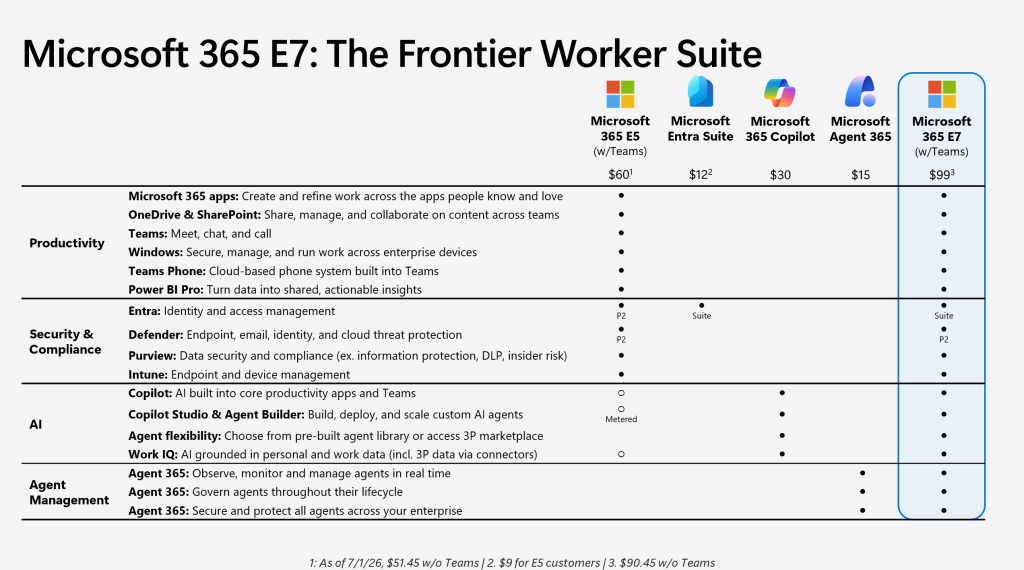
Observe. Govern. Secure. That is the trifecta of trust for Agent 365 as it will launch in May 2026. Clearly an enterprise focused angle that addresses the concerns of those who are technically responsible for the IT tools an organization provides to its workers.
The one verb Agent 365 avoids is the most important one: Do. The product offering as it is being launched for GA is not about offering any new tools for the agents to do their work. Or for the agent makers on the business side to build more advanced things. It is merely about the control plane for someone else to monitor what’s going on in the AI land.
At launch, the part of Agent 365 that is about enabling true digital workforce to join the organization is still missing. Users with either Microsoft 365 E7 or a standalone Agent 365 license assigned to their Entra ID account will be able to work with agents that act On Behalf Of (OBO) that human user. More autonomous agents are not yet in the scope of what Agent 365 GA or its $15pupm license offers.
Autonomy will arrive in the fullness of time
The launch pitch from Ignite 2025 and what we’ve seen in parts of the Agent 365 documentation already go beyond the OBO scenario. Microsoft’s vision is clearly to have a new form of digital workers that become part of the organization with their own identity. As Satya Nadella has said, such agents will need an identity, tools, and a computer to use.
None of that will arrive with Agent 365 in its GA version. As one example, compare the “included capabilities” section on the Agent 365 website in December with how it looks now:
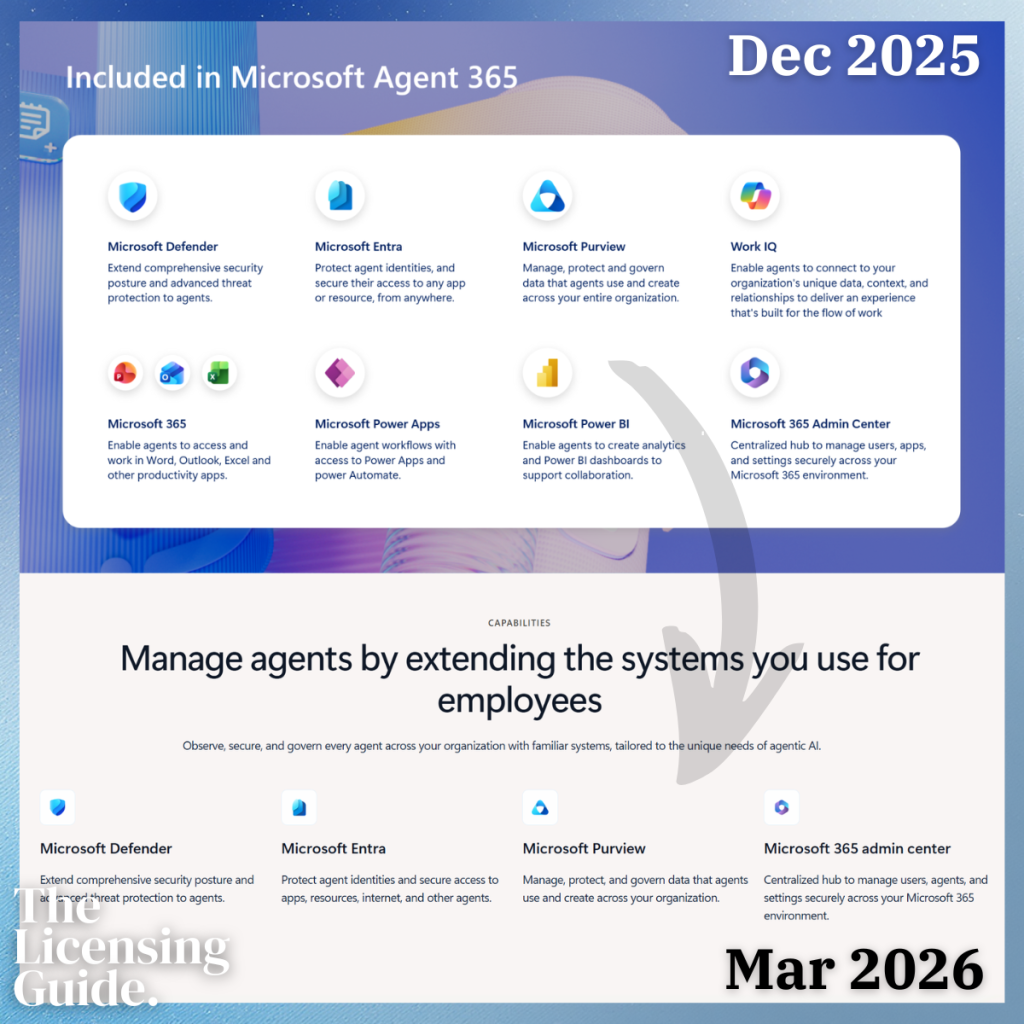
“Where did all the apps go?” They are not needed for the kinds of agents that Agent 365 will cover in May 2026. For the OBO scenarios, Microsoft has stated that these agents are operating with the licensed M365 end user’s identity still. Even when it comes to Copilot Studio agents, in the AMA session those were also described to be acting on behalf of the agent maker.
So, just because the agents have been automatically listed in the Entra ID directory ever since the preview of Entra Agent ID was launched almost a year ago, true agentic worker identity will not arrive in the Microsoft cloud just yet. Out of the two authentication flows that Entra Agent ID supports, only the On-Behalf-Of (OBO) flow will be an Agent 365 GA feature. Agent identity authentication will remain in preview by the looks of things.
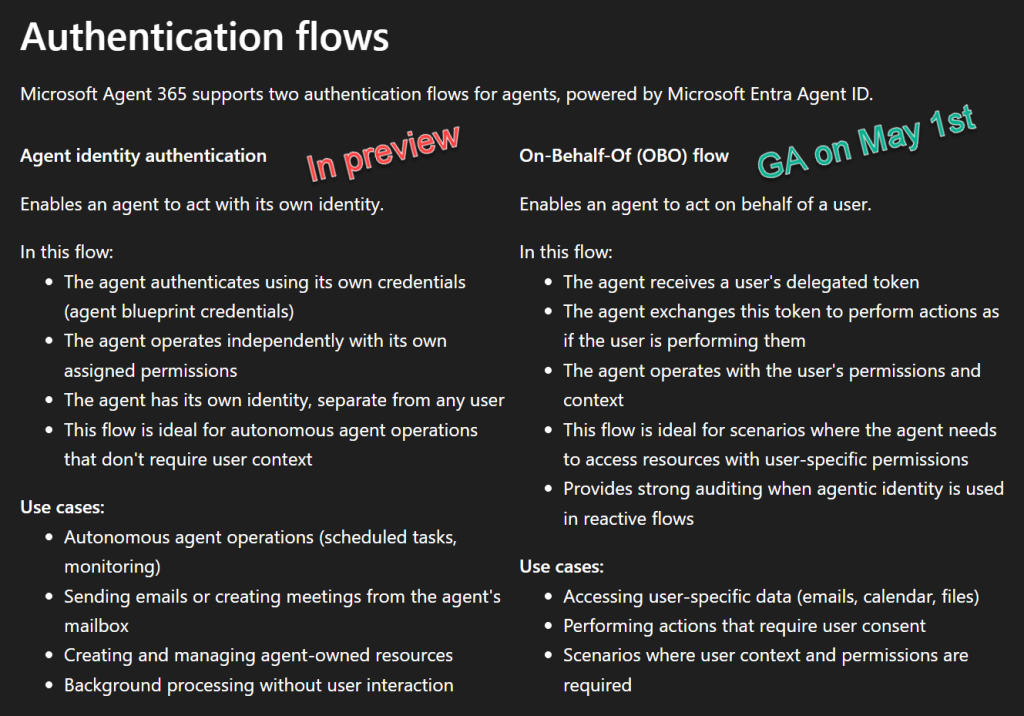
In the OBO model, the agent receives a user’s delegated token. The agent is working in the same way as a classic Power Automate cloud flow would. A human user in the M365 tenant built the automation and then the credentials from that user get stored inside MS cloud, kept alive via a refresh token. If that user leaves or the license of that account is removed, the automation dies.
This is a key Power Platform governance challenge that I have spent the five past years addressing in customer environments as part of the consulting services I’ve provided. What are today called Copilot Studio agents used to be Power Virtual Agents chatbots, long before ChatGPT came along. The core architecture of such agents has been bolted on top of an IAM system designed for humans. It’s how things often work in the MS cloud today, but it’s hardly the ideal state for the agentic future.
Autonomous AI agent licensing remains TBD
What we have learned from the M365 E7 launch is that there is a per user component in Agent 365 licensing. When thinking about A365 as a control plane on top of the various AI agents that have already been built and deployed in customer tenants, that model makes sense. The majority of the current agents will not be of high enough business value or criticality to warrant a dedicated agent license to be assigned to them. In fact, it would encourage customers to ask a question that’s not in the software vendor’s interest at this point: “do we really need all these agents?”
Since Microsoft has sold additional security and compliance features for customers to govern and protect the work and data of human users, by upselling them to M365 E5, it makes sense to repeat this pattern for the agent layer. Positioning the offering as protection for all agents, built on Microsoft or other vendors’ technology, is riding on the trust and familiarity of MS tools compared to the new AI era competitors. The technology is largely in place already, thus A365 and E7 are ready for GA.
The technology that is not yet ready, the framework for truly autonomous digital workers, remains in Frontier preview. The 3-month trial licenses issued during Ignite 2025 had already expired while customers were still waiting for the underlying Agent 365 features to become testable. Recently, those same trial licenses were silently replaced with a new version that is valid until December 2026 (read: past the coming Ignite 2026 keynote).
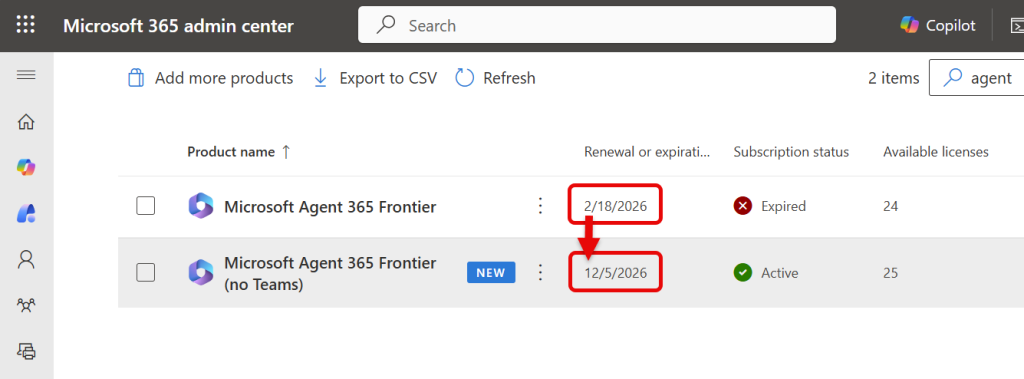
This is a signal that the Agent 365 Frontier program will remain active after GA and work towards the eventual release of AI teammates with their own identities, mailboxes, OneDrives, and so on. In the A365 AMA session this was mentioned by one product team member as their favorite feature, giving some perspective on how the GA scope of an agentic control plane is likely not the most exciting technical achievement here.
Once we’re at a point where the autonomous agents with their own apps and computers are actually running in the Microsoft cloud for Frontier customers, it will be easier for everyone to estimate how much such a service might cost once generally available. At this point, some combination of per-user, per-agent, and capacity-based licensing must still be on the table for whatever Microsoft Agent 365 becomes once it grows beyond being merely a control plane for OBO agents.