

It has now been one month since Microsoft launched its latest 365 product at the Ignite 2025 conference. Since then, we’ve had Agent 365 trial licenses available via the Frontier preview program for those who want to explore the capabilities. One challenge with this, though, is that there have been no agents from MS yet for which you could assign the A365 license.
Upon the launch announcement, I created the Agent 365 FAQ site as an unofficial guide to help customers get answers to their most likely questions. Using Microsoft’s own documentation and blog post, it gathered information and presented it in a more neutral way than the official vendor pitch.
One of the open questions at that time was: What is the exact licensing and pricing model for Agent 365 at general availability?

We still don’t have official information on the exact licensing model, nor a target date for when Agent 365 general availability could be expected. What Microsoft has published, though, is their own Agent 365 FAQ document. Available via MS partner portals that require no authentication, this document is available for download to all those who know where to look. It includes some information that help customers prepare for the eventual commercial launch of A365.
In this post, I will look at Agent 365 licensing aspects that we now have more certainty on than one month ago.
Will Agent 365 be included in Microsoft 365 E5 or E3?
This is one of the previously open questions that now has a firm answer:
No, Agent 365 is not included in M365 E3/E5 licenses – it’s a separate offering. Microsoft 365 is for users and Agent 365 is built for agents – this allows customers to enable purpose-built capabilities for users or for agents and balance their user and agent budget.
This aligns with my personal expectations from day one. Surely Microsoft would not create a whole new 365 category offering and then immediately fold it into existing licenses as a bundle. While certain capabilities on the admin side are likely to be available with limited scope for all M365 customers, the full A365 product must drive new revenue independent from purchases of other Microsoft licenses.
UPDATE 2026-03-07: As has been widely reported, the new Microsoft 365 E7 will also include Agent 365 entitlements. For a much bigger price tag.
Will Microsoft 365 Copilot include Agent 365?
Also no. While we know from leaked numbers that Microsoft 365 Copilot has not been a commercial success so far, it is unlikely that we would see a direct rebranding of M365 Copilot into A365. The positioning of these two products in the Microsoft cloud stack is complementary:
Copilot is about what AI can do; Agent 365 is about controlling what AI is allowed to do.
Microsoft intends to monetize both the users and the AI agents. This has been made clear by Satya Nadella in his recent interview:

What will Microsoft Agent 365 license include?
To allow AI agents to operate in the same environment as the human “sponsors” of those agents, they will need to have access to most of the same tools as the employees of a Microsoft cloud customer organization do today. The picture below illustrates what has also been published on the included capabilities section of the Agent 365 product website:

Some of the capabilities will be specific to the agentic workforce, such as Entra Agent ID. Others on the list are more generic, applying to both human and digital workers, such as:
- Microsoft Power Apps: Enable agent workflows with access to Power Apps and Power Automate.
- Microsoft Power BI: Enable agents to create analytics and Power BI dashboards to support collaboration.
I have previously written about the Microsoft cloud product layers and Agent 365, mapping how the existing capabilities are leveraged now when MS is creating an offering tailored for the coexistence of human users and agentic users:
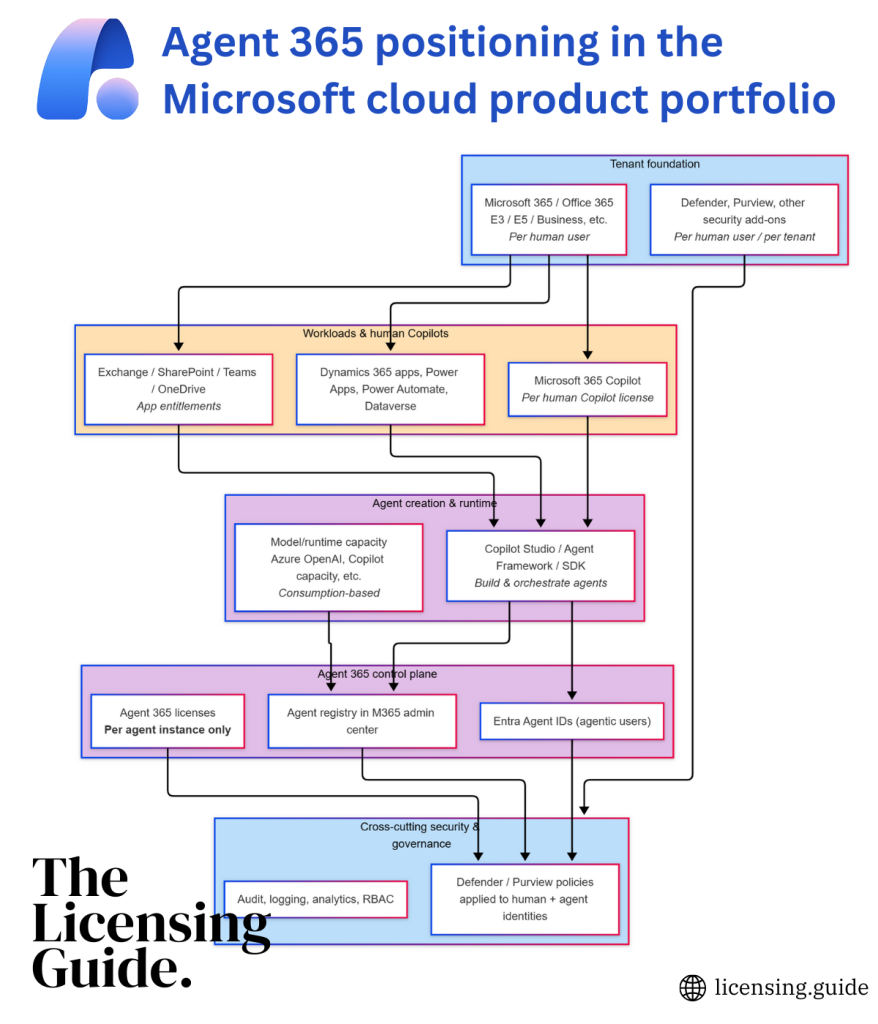
The open question that we don’t have any firm information on is whether the per-agent A365 SKU will provide some form of capacity bundles, such as Copilot Credits or the ability to run Windows 365 virtual machines for AI agents.
Will every AI agent need an Agent 365 license?
No. This would be very difficult for Microsoft to enforce at a time when they’ve been launching services called “agents” all across their existing product portfolio. Ranging from simple information retrieval tools like SharePoint agents to near-autonomous Copilot Studio agents with tools access and triggers, the term “agent” is about as descriptive as “app”.
Instead, what Agent 365 is aimed at is what one might describe as “business critical agents”. Similar to how the launch of Microsoft Power Apps a decade ago enabled basically any Office 365 user to create simple apps, the current tooling in Microsoft 365 Copilot encourages users to build agents for themselves with as little friction as possible. However, only a small subset of such agents (or apps) would ever become something that should require active IT oversight.
Microsoft recommends that once the AI agents become shared broadly within the organization, handle sensitive/regulated information, or are given autonomous actions to perform on behalf of the org, these should be governed with Agent 365 capabilities. Just like the Managed Environments concept in Power Platform has required that Power Apps and Power Automate artifacts under such IT guardrails are licensed with a Premium license, A365 could be seen as the “premium agent license”.
Will agent developers use Agent 365, too, instead of Microsoft Foundry?
These are two sides of the same AI coin. Agent 365 is intended to serve as the IT admin’s control plane, whereas similar security capabilities required by software development teams are offered via the Foundry Control Plane:

From a licensing perspective, the use of Azure AI Foundry services will remain firmly under the existing consumption-based model of Azure subscriptions. Now, while we don’t yet know whether the rise of pay-as-you-go model in M365 services means Agent 365 would have a PAYG option, too, it is quite likely for the base offer to be grounded on the prepaid model familiar from core Microsoft 365 services.
Because that is ultimately Microsoft’s target here: to establish a per-agent equivalent for the SaaS business model of Microsoft 365 and its per-user licensing.