

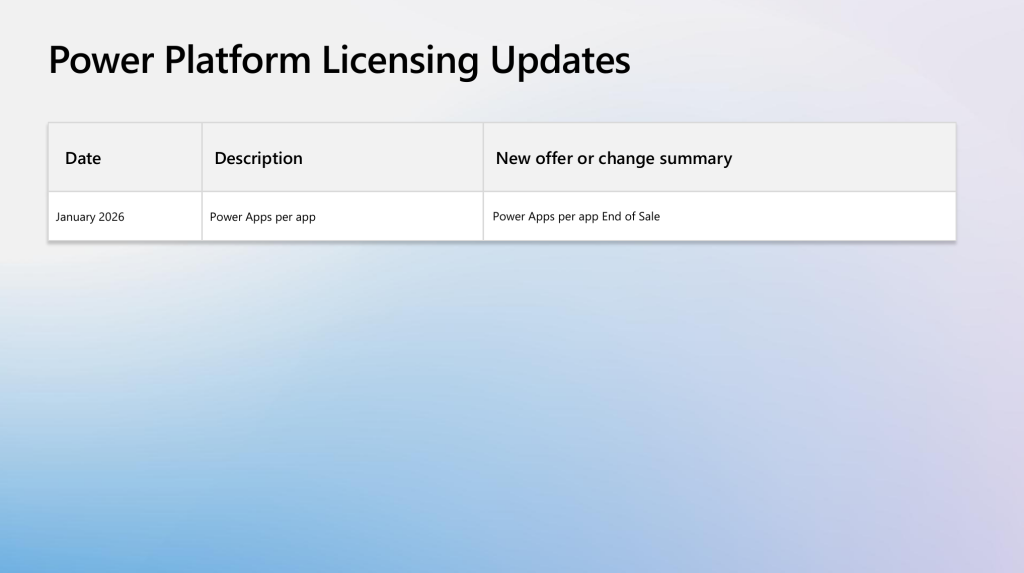
In January 2026, the licensing guides and decks for Power Platform were updated with the news many had been speculating about for a couple of years: Power Apps per app plan is dead.
This doesn’t (yet) mean the complete removal of per app licensing model in Microsoft business apps, yet it is a major milestone worth exploring in more detail.
How the per app model came to be
Back in 2019, Microsoft was turning its low-code application platform into a proper commercial offering of its own. What had previously been done via the XRM idea of Dynamics CRM/365 and through Office 365 bundled Power Apps entitlements turned into a proper product actively sold by MS reps. The old SKUs of Plan 1 and Plan 2 were replaced with a new model: you could buy Power Apps as either per user or per app.
I wrote about this application/platform separation in my personal blog:
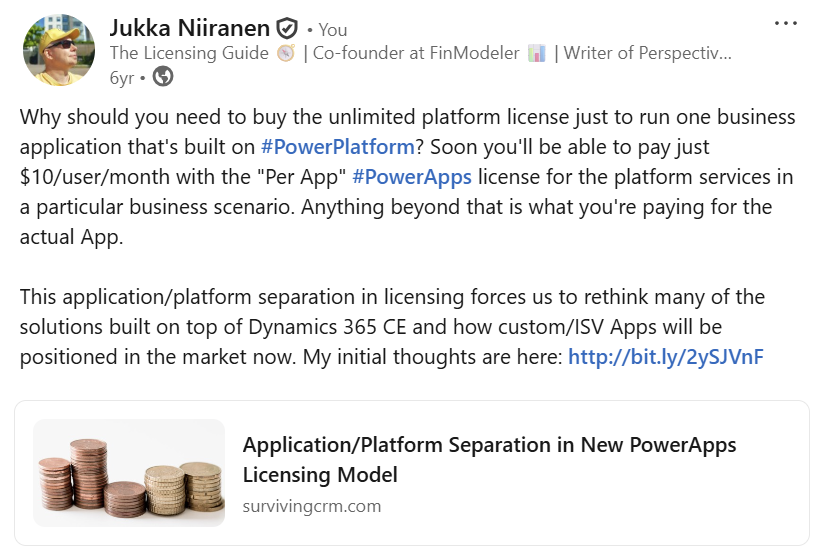
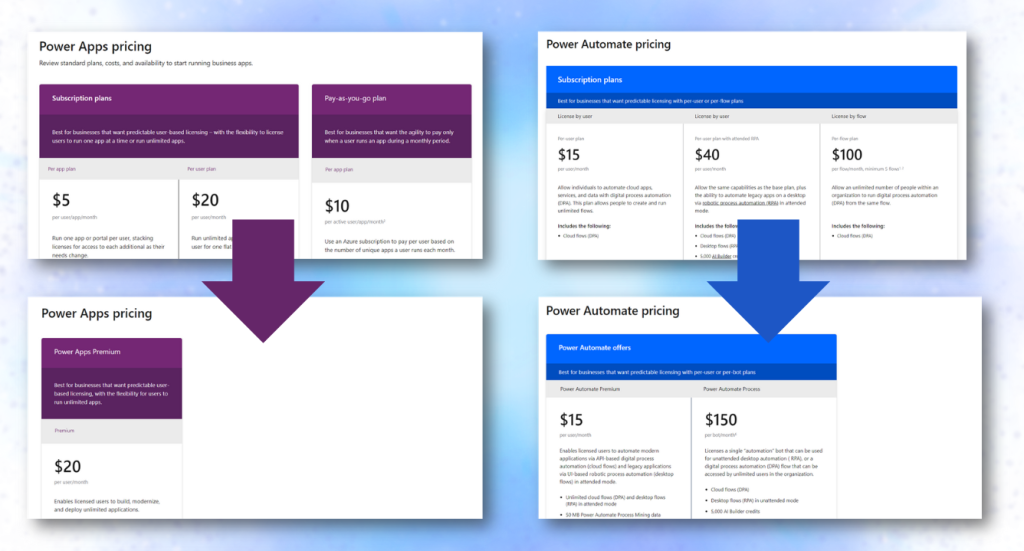
The initial price points of $40 per user and $10 per app were cut in half two years later, as Microsoft sought to turn the premium Power Platform licenses into an essential element included in enterprise licensing agreements. After the initial instability of the licensing model, things cooled down and the $20/$5 price points introduced in 2021 remained in place.
2023 saw a change in both SKU naming and marketing communication. As Microsoft updated their Power Apps pricing page to show only the new Power Apps Premium license (renamed from Power Apps per user), customers and partners started to ask the question “did the Power Apps per app option get removed”? At that point, this was merely a marketing change though and detailed guides and commerce experiences continued to offer the per app option like before.
Soon after, some MS reps began telling customers that Power Apps per app would no longer be available for purchase starting February 2024. The forum threads are no longer available, but my LinkedIn post provides this piece in the Power Apps licensing puzzle.
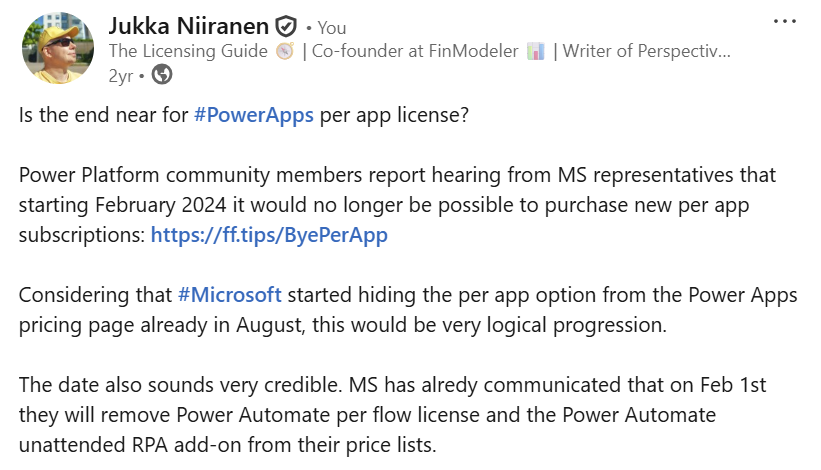
As is unfortunately often the case, just because customers and partners hear Microsoft employees say something, that doesn’t mean it’s true. Nothing happened in 2024, nor in 2025. It took all the way until 2026 for us to get the official notice on the end of sale for Power Apps per app SKU. And even then, we see it as a single sentence added in the PDF documents, rather than a clear explanation of what is happening and how customers will be affected.
UPDATE: Microsoft published official blog posts about the per app EOS policy implications for new and existing customers. I’ve covered them in this blog post:
UPDATE 2026-03-17: Microsoft have now decided to keep the Power Apps Per App license available for new customers via the CSP (Cloud Solution Provider) channel:
The impossible license
I’m sure many people will be happy to see the Power Apps per app license finally go away. That’s because Microsoft never managed to make it work in reality. The initial 2019 version of how the license entitlements were defined (“run max 2 apps and 1 portal within an environment”) made it mission impossible for the product team engineers to implement the technical rules for how such a license should behave. But a lot of questionable licensing decisions were made in 2019 for Power Platform in general, resulting in what can only be described as a FUD strategy.
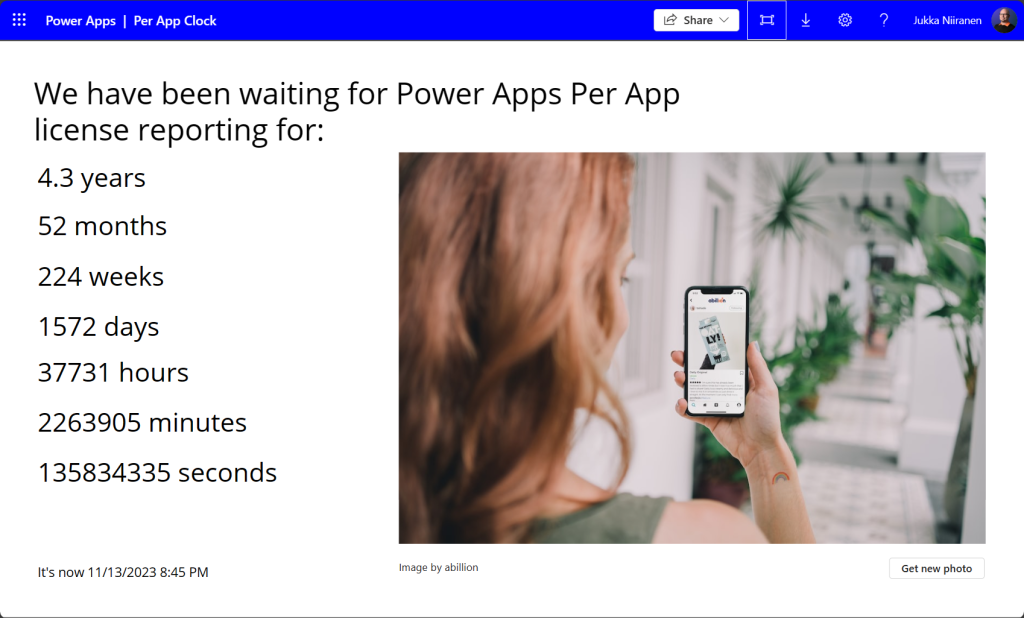
Even after the 50% price cut simplified it to “per app = actually 1 app”, the allocation and reporting for Power Apps per app continued to be a mess. It was impossible to know who and which apps had been assigned a license as there was no reporting available on this. In addition to frequently communicating directly to Microsoft product team about this severe gap, I created internal memes about this licensing reporting gap. Such as the canvas app “Per App Clock” that showed how long we had been waiting for proper reporting of this crucial data for admin and compliance needs:
Eventually, as the Power Platform Admin Center (PPAC) received updates into its licensing area, some visibility was provided on the usage of Power Apps per app licenses. However, detailed data on what Microsoft’s systems said about specific apps and users having per app licenses assigned was never made available to the general audience, presumably due to unavoidable gaps that exist in tenants that had adopted these licenses early on.
Per app options after the end of sale
As always, we need to be specific about what is said in the updated licensing documentation. Microsoft is ending the sale of the Power Apps per app plan. Yet that is not the only model where the per app licensing concept is applied. As we can see from the updated Summary of Power Apps table, the Power Apps per app meter remains:
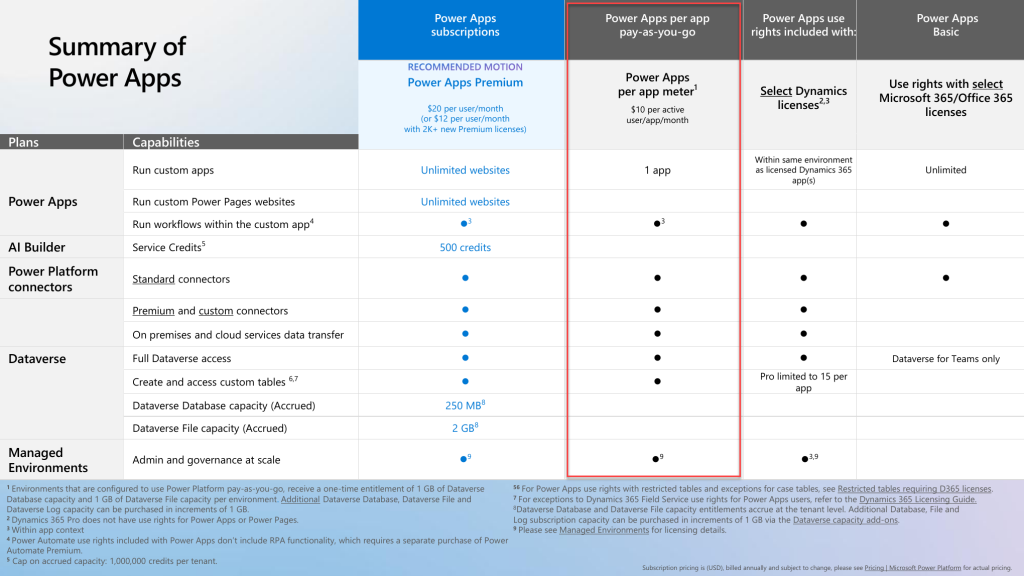
This makes a lot of sense, because it’s obvious how Microsoft is pushing customers towards the consumption based model. Pay-as-you-go licensing for Power Apps has been available since 2021. Today, with AI services like Copilot Studio being strategically extremely important for Microsoft, encouraging customers to implement PAYG billing plans with Azure subscription billing mechanism is one way to nudge everyone into the right direction.
There is of course a price difference between prepaid vs. pay-as-you-go options. Per app costs for Power Apps customers will jump up 100% from $5 to $10 once the old SKUs become unavailable (no dates have been published yet for when this will happen). But only if the apps are used every single month. For casual app usage patterns where the Power Apps access is not daily or weekly, there’s a chance for PAYG to reduce paying for a license that is not being used.
One could say that the per app option was always aimed at getting customers started with low-code business apps in the Microsoft cloud without a massive upfront commitment. We saw promotional packages of per app licenses being sold and bought “just in case”, back when Power Apps was still a new concept. Today, customers should be able to better determine what value they are getting out of their Power Platform investments. Removing the opaque per app plan with its high admin overhead from the equation can make it easier to both calculate as well as automate Microsoft licensing related processes.
If you’re unclear about the options that exist for licensing the Microsoft Power Platform, Dynamics 365 and Copilot related capabilities in the year 2026, feel free to reach out for one-to-one advisory services from an expert with 20 years of practical experience in designing Microsoft-based business solutions.


Pingback: What should Power Apps per app customers do now? - The Licensing Guide.
Pingback: CSP Exception for Power Apps Per App EOS - The Licensing Guide.