

Microsoft publishes licensing terms as documents that an LLM can surely read. If providing answers to licensing questions was merely a matter of searching through text and identifying what the likely relationships between each token are, AI chatbots would be perfectly suited to solve these problems.
The reality is a bit more complex. Merely throwing a licensing guide PDF at ChatGPT will not necessarily offer reliable answers in return. Especially when it comes to numbers, a large language model alone is hardly the optimal tool for the task. The question is: could we provide the LLM better tools that it could use as part of providing answers to users?
This is what I have experimented with recently.
Calculator UI for humans
In December 2025, I published the Dataverse Capacity Calculator as an app you can access and freely use at https://dataverse.licensing.guide. It is a small web app that allows entering the number of different Dynamics 365 CRM/ERP licenses and Power Platform product licenses as input and getting the amount of default and accrued Dataverse storage capacity in return.
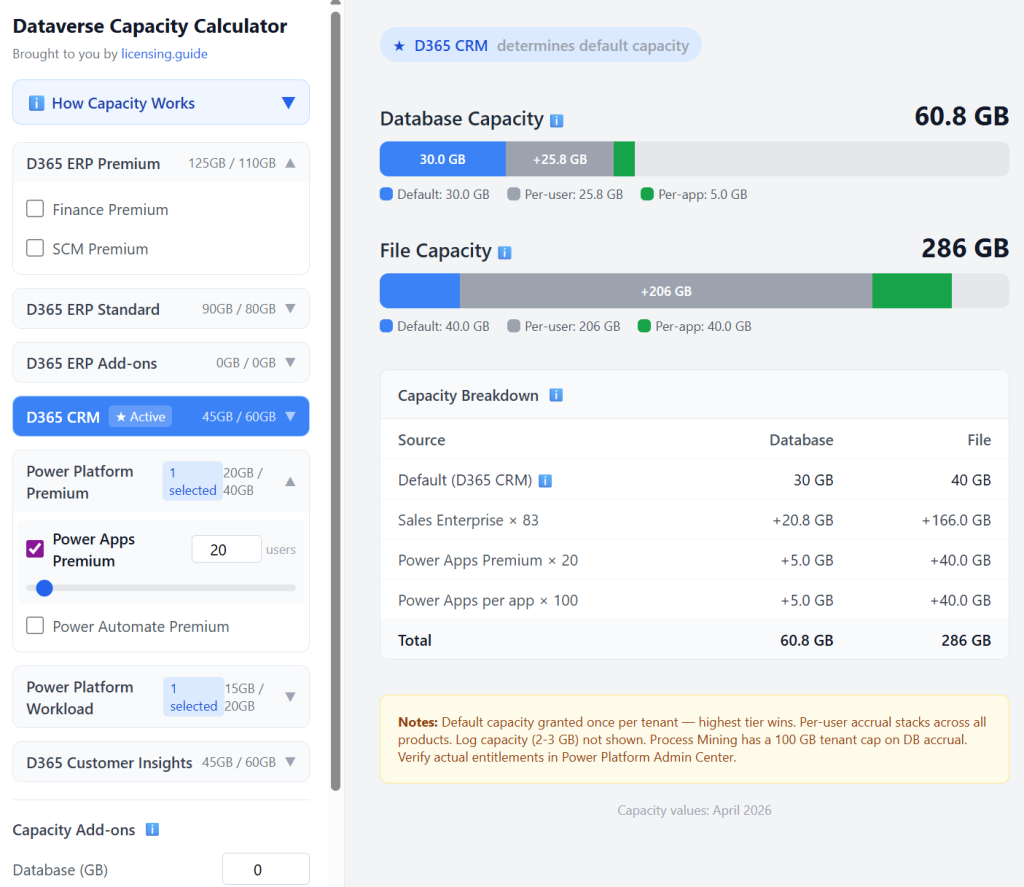
This calculator visualizes the logic that is normally buried in the static tables published in Microsoft’s licensing guide PDFs. By dragging the levers to adjust the licensed seat count, you can easily explore different combinations and their impact to tenant-level Dataverse database and file capacity.
The app is not too many lines of code and you can inspect it for yourself on GitHub. Just ask your own AI agent to analyze the repo and confirm any questions you may have about the logic. And if you happen to find bugs or think of useful enhancements, you can open an issue or even directly contribute a PR.
MCP Server for AI Agents
The problem with graphical UI’s is that they are optimized for humans that observe the world through their eyes and navigate it with mouse clicks. This isn’t optimal for a large language model that would preferably operate with just text and code.
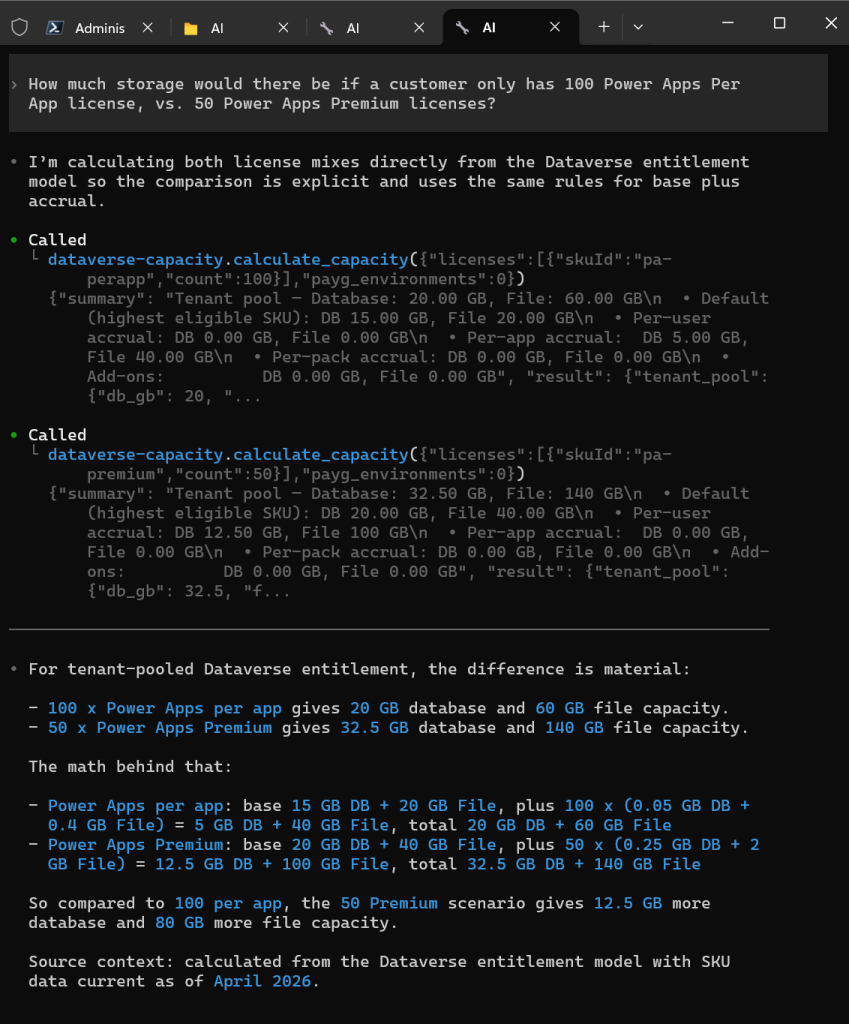
Now, the very same logic of the Dataverse Capacity Calculator app is available to AI agents via the Dataverse Capacity MCP Server. Just like with the calculator, you can access it freely via the public endpoints described in the GitHub repo docs. Below is an example of how it works after I’ve added the MCP server to my Codex CLI:
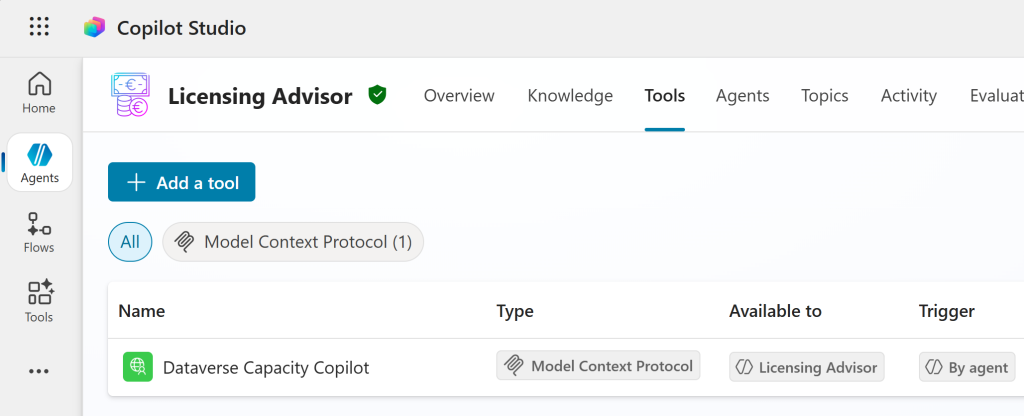
You don’t need to use software developer tools to benefit from the Dataverse Capacity MCP Server. It can be easily added into your Copilot Studio agent, for example. See MS Learn for instructions on how to complete the process to make the MCP server show up under your agent’s tools:
When using your agent via Copilot, it can interact with the MCP server by sending the necessary parameters (what products, how many licenses). The MCP server will respond back with the calculation data, which Copilot can then format and adjust for the context of the original question:
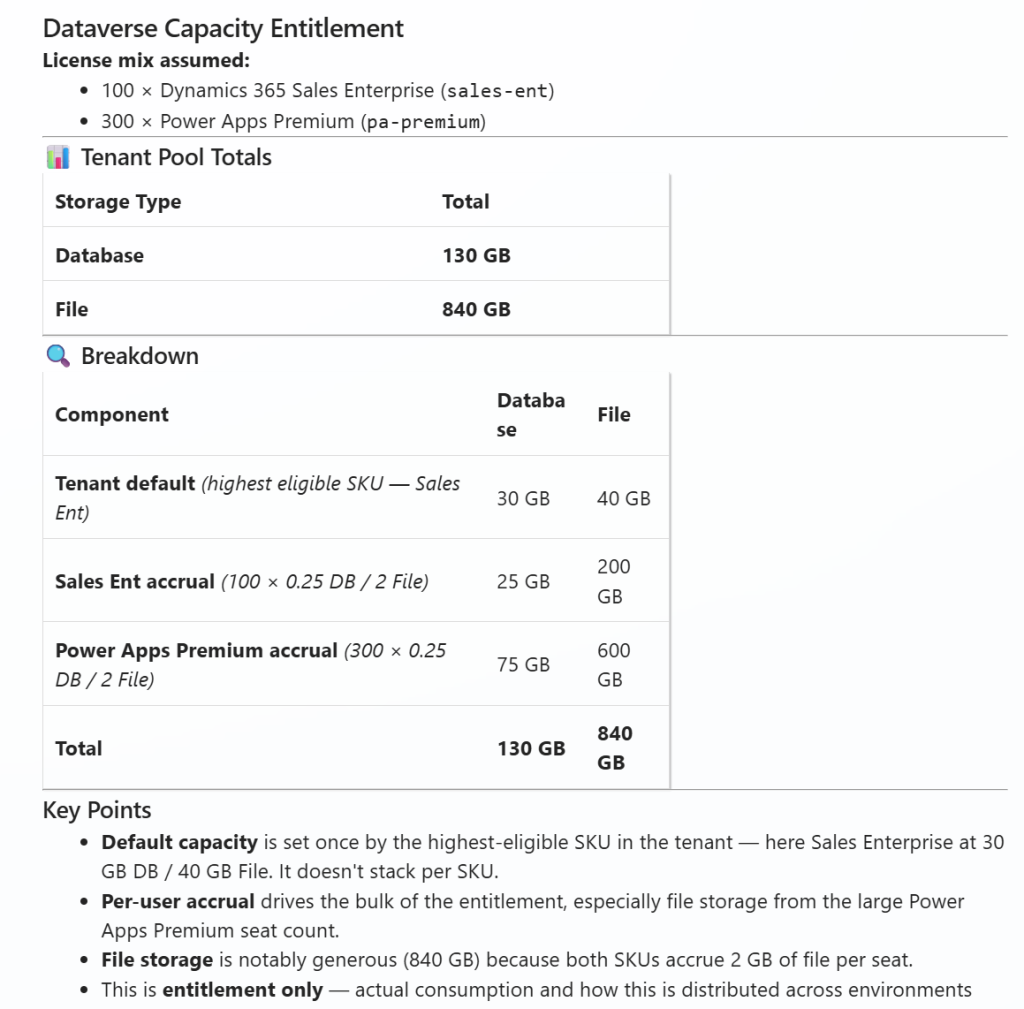
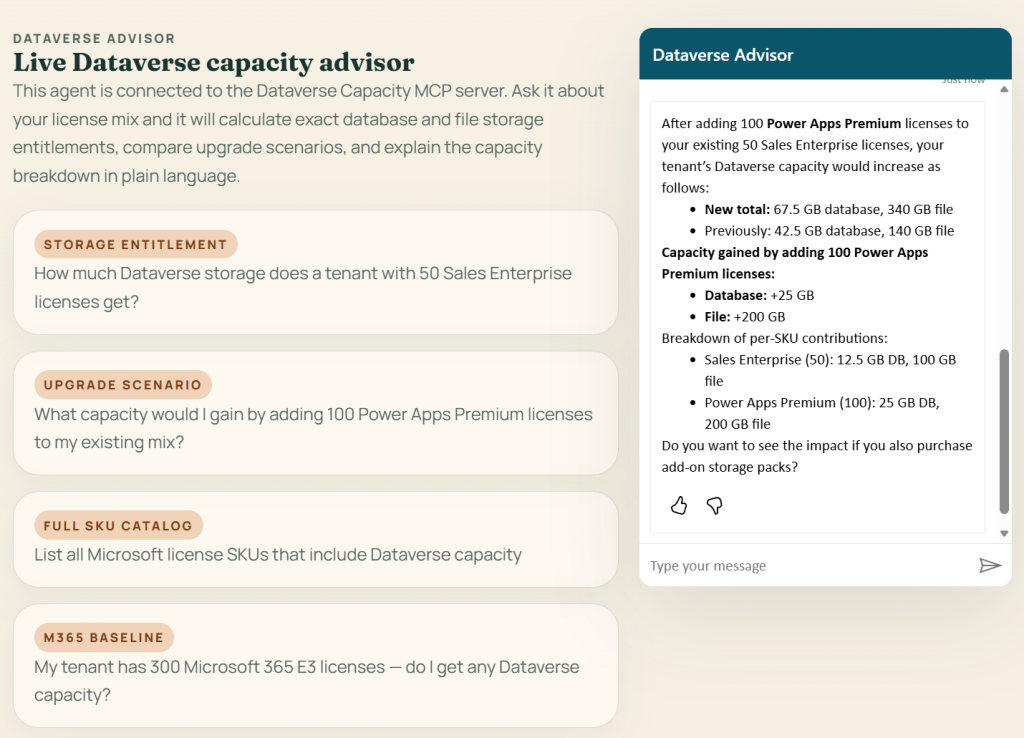
This approach offloads the detailed calculation of Dataverse database and file storage entitlement calculation to a deterministic system. All the AI agent needs to do is provide a few details to the MCP server. It does not have to interpret the logic from written text in Microsoft’s licensing documentation every time an answer is needed. Now, we can surface a Copilot Studio agent that calls this MCP as a tool anywhere we want. Like on this demo Power Pages site I put together for my upcoming presentation at the DynamicsMinds 2026 conference:
Converting the licensing terms into computer code is done at a singular point: the design, development and testing of the Dataverse Capacity Calculator. While not immune to errors and ambiguity, it at least ensures that the resulting tools work in a repeatable way. This takes us one step closer to treating licensing as code.
As the Power Platform, Dynamics 365 and Copilot Studio licensing model evolves, the calculator and MCP code must also be maintained. For example, the recent expansion of default capacity in Dynamics 365 Sales Premium has been updated to the calculation logic in April:
When it comes to MCP servers, they are of course a concept that Microsoft has wrapped inside its licensing terms in the world of Dynamics 365 and Microsoft 365 Copilot. Check out my earlier article on Dataverse MCP Server licensing requirements for details on what the surprising cost impact of using Microsoft’s 1st-party MCP servers may be to your developers.